Aquae Calidae: A Thermal Spring Thousands of Years Old
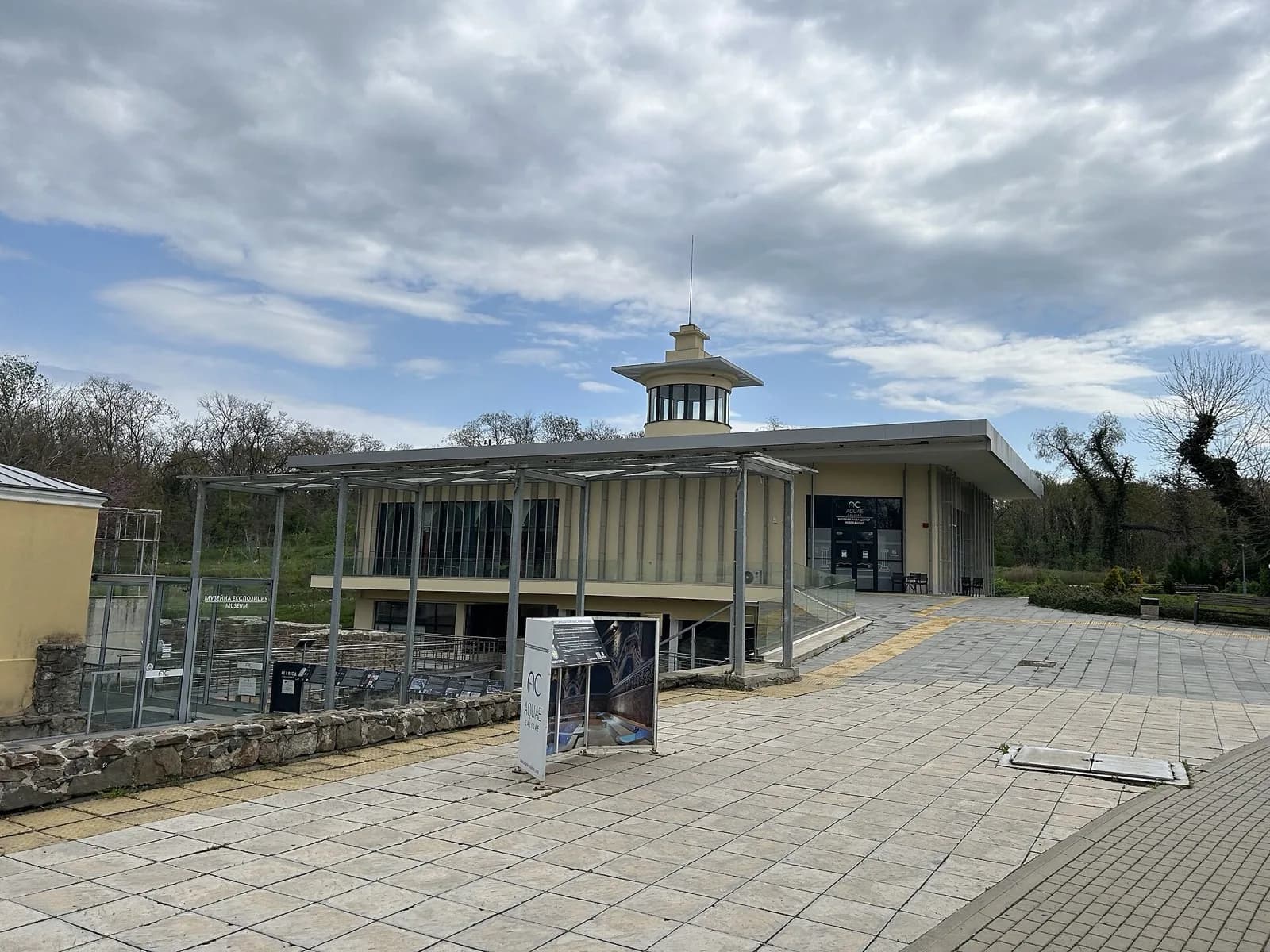
On the border of the Vetren and Banevo neighbourhoods of Burgas, Aquae Calidae is an ancient settlement that gathers Thracian, Roman, Byzantine, Bulgarian and Ottoman layers around hot mineral springs; today it can be toured as a restored museum complex.
Aquae Calidae means “hot waters” in Latin. According to Wikipedia, the settlement lies within today’s Burgas, on the lands of the Vetren and Banevo neighbourhoods; in medieval sources it appears under the names Terma and Thermopolis. Archaeological finds show that the spring’s healing properties have been known since the Neolithic, and that three settlements from the 6th–5th millennium were founded near it. In the middle of the 1st millennium BC the Thracians turned the spring into a “Temple of the Three Nymphs”.
From Rome to the Middle Ages
Under Roman rule, during the reign of Trajan (98–117), neighbouring Anchialos was chosen as the administrative centre of the region and the baths were expanded with two large pools. On the Via Pontica built around the same time, a road station called Aquae Calidae was established next to the baths; the name also appears as a road station on the Peutinger map. The sources mention that in the time of Septimius Severus (209–211) special festivals and games lasting three years were held here, and that Emperor Justinian had walls built around the area. It is told that Khan Tervel defeated Justinian II in this region in 708. When Henry of Flanders captured and burned the town in 1206, Thermopolis never recovered; the baths, however, were repaired again.
The Ottoman-era trace, according to Wikipedia, is Suleiman the Magnificent: in 1562 he came to the bath to treat his gout and had a new bath built over the half-ruined Bulgarian pools; the “Sultan’s Bath” has survived to this day. The nearby settlement took the name Лъджа (Lıdja) in those years from the Turkish word ılıca, and in the 20th century became successively Banya and Banevo.
The complex today
The first scientific excavation was carried out by Bogdan Filov in 1910. Large-scale work began after 2008, and in July 2011 an area of about 36,000 m² was declared the “Aquae Calidae – Thermopolis” archaeological protected area. The restored museum complex opened on 18 September 2015. The complex’s own website describes the wall remains of Terma, the Roman bath dated to the 1st century (with its warm and cold pools), the remains toured from walkways, the floor where finds such as gold coins, jewellery and lead seals are displayed, and the restored Suleiman Bath.
- The remains are viewed not directly but from the walkways that have been built; the visit follows a flow listed as exhibition, virtual zone and ancient remains
- In the Suleiman Bath a film with three-dimensional projection tells the history from the Thracian legend to the Ottoman period
- Bulgarian names: Акве Калиде (ancient name), Термопол (medieval name), Бургаски минерални бани (today’s neighbourhood name)
Source: Aquae Calidae museum complex, official website — http://www.aquae-calidae.com/ ; Wikipedia (bg), “Акве Калиде” — https://bg.wikipedia.org/wiki/Акве_Калиде ; Wikipedia (en), “Aquae Calidae, Bulgaria” — https://en.wikipedia.org/wiki/Aquae_Calidae,_Bulgaria . Accessed: 2026-10-07.
Text licence: The text of this article has been adapted into English from information taken from Wikipedia (CC BY-SA 4.0); it has been summarised and rewritten, i.e. MODIFIED. Under the same licence condition (share-alike), this article is also offered under the CC BY-SA 4.0 licence: https://creativecommons.org/licenses/by-sa/4.0/deed.en. The source pages are listed in the "Source:" line above.