The Burgas Ethnographic Museum
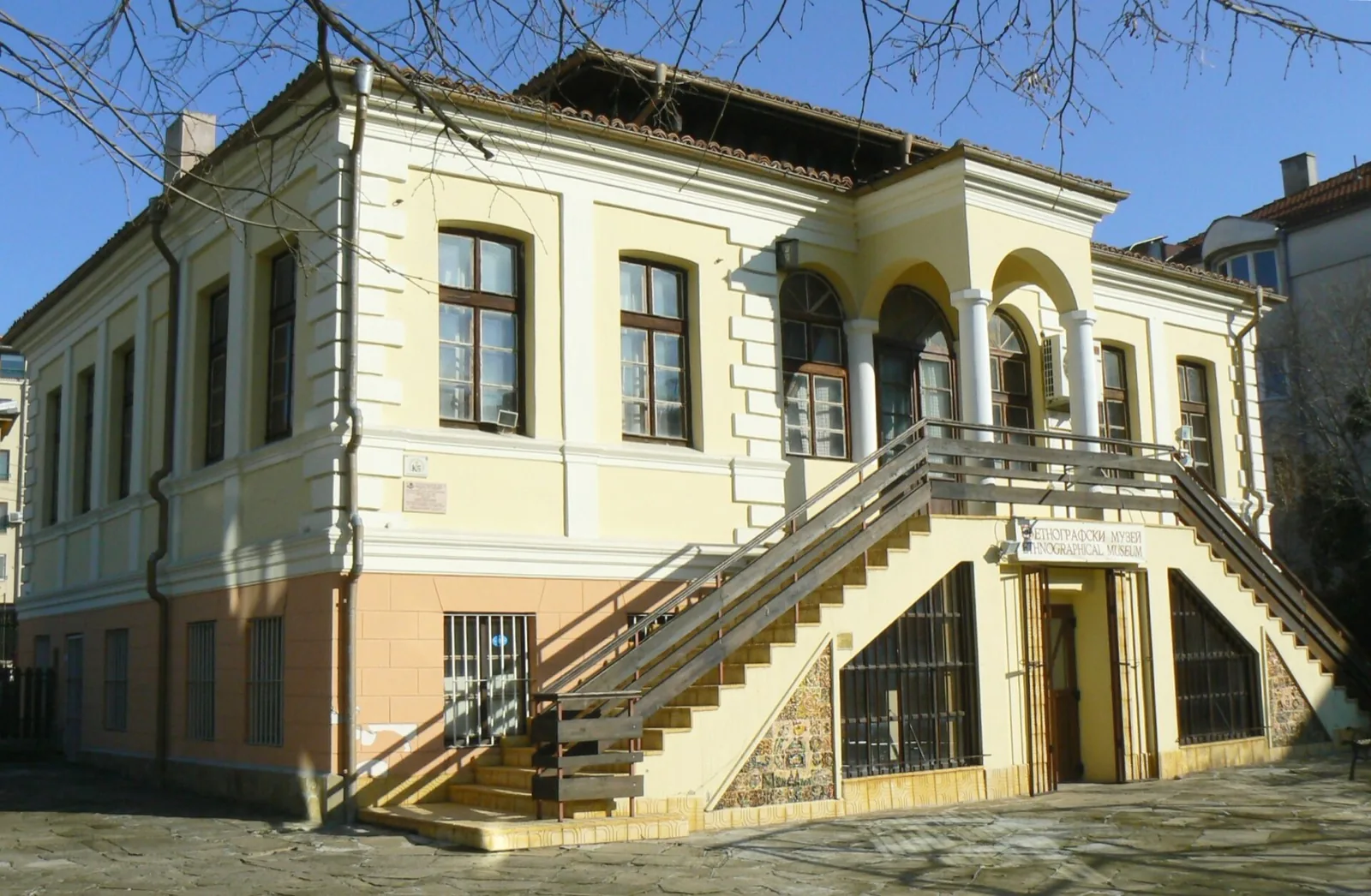
Photo: Vassia Atanassova (Spiritia) / CC BY-SA 3.0 — Wikimedia Commons
The Ethnographic Museum, housed in the Brakalov House of 1873 next to the Cathedral of Saints Cyril and Methodius, displays the traditional costumes of the Burgas region and of refugees from Greece and Türkiye.
The Burgas Ethnographic Museum is one of the exhibition units of the Regional History Museum in the city centre. According to the Bulgarian Wikipedia, the building that houses the museum is the home of the entrepreneur Dimitar Brakalov; the house, built in 1873, has been declared a cultural monument and stands right next to the cathedral. The regional museum’s own website writes that the institution began in 1912 as the private museum of the Debelt Archaeological Society and today consists of four main exhibition units in monumental buildings in the city centre. According to the Bulgarian Wikipedia, the ethnographic exhibition tells the story of the ethnographic groups of the different peoples who have lived in Burgas; the collection includes traditional Bulgarian costumes of the people of the Burgas region and of refugees from Greece and Türkiye.
What is in the collection?
According to the Bulgarian Wikipedia, the house is an example of a 19th-century Balkan-type town house.
In the museum’s online collection the ethnographic fund is divided into the following headings: town life, metal, clay and leather, wood, weaving, photographs and documents, jewellery.
- The costumes in the collection cover the regional dress of the people of the Burgas region as well as of refugees from Greece and Türkiye (Wikipedia bg)
- The cathedral, Troykata Square and the Archaeology exhibition on Aleko Bogoridi Street are in the same central area
- For Strandzha’s fire-dancing tradition nestinarstvo, see the article on Strandzha Nature Park
- In Bulgarian, folk costume appears as народна носия (narodna nosiya) and ethnography as етнография (etnografiya)
The exhibition floors
According to the museum entry in the Bulgarian Wikipedia, the house was built in 1873 for Dimitar Brakalov, a well-known community leader and mayor of Burgas. On the first floor the interior arrangement of a 19th-century Burgas town house and the women’s fashion of the period have been recreated; the spacious foyer is reserved for temporary exhibitions.
According to the same source, the second floor displays the traditional Bulgarian costumes of all the ethnographic groups of the Burgas region: the dress of the rupci, tronki, zagortsi, planintsi and aliani groups, and the clothing of Bulgarian emigrants from the lands of present-day Greece and Türkiye. There are also ritual costumes and jewellery from the 19th century, which relate to the customs and folk festivals of the area. As examples, Wikipedia lists the costumes of the nestinarka, the Enyova bulya, the lazarka and the Karakachan bride, as well as real wedding clothes from the village of Zidarovo.
Source: Wikipedia (bg), “Забележителности в Бургас” — https://bg.wikipedia.org/wiki/Забележителности_в_Бургас ; Wikipedia (bg), “Етнографски музей (Бургас)” — https://bg.wikipedia.org/wiki/Етнографски_музей_(Бургас) ; Burgas Regional History Museum, “За нас” — https://burgasmuseums.bg/bg/about and “Колекция” — https://burgasmuseums.bg/bg/collections . Accessed: 2026-10-07.
Text licence: The text of this article has been adapted into English from information taken from Wikipedia (CC BY-SA 4.0); it has been summarised and rewritten, i.e. MODIFIED. Under the same licence condition (share-alike), this article is also offered under the CC BY-SA 4.0 licence: https://creativecommons.org/licenses/by-sa/4.0/deed.en. The source pages are listed in the "Source:" line above.