Bulgarian Yoghurt (Kiselo Mlyako)
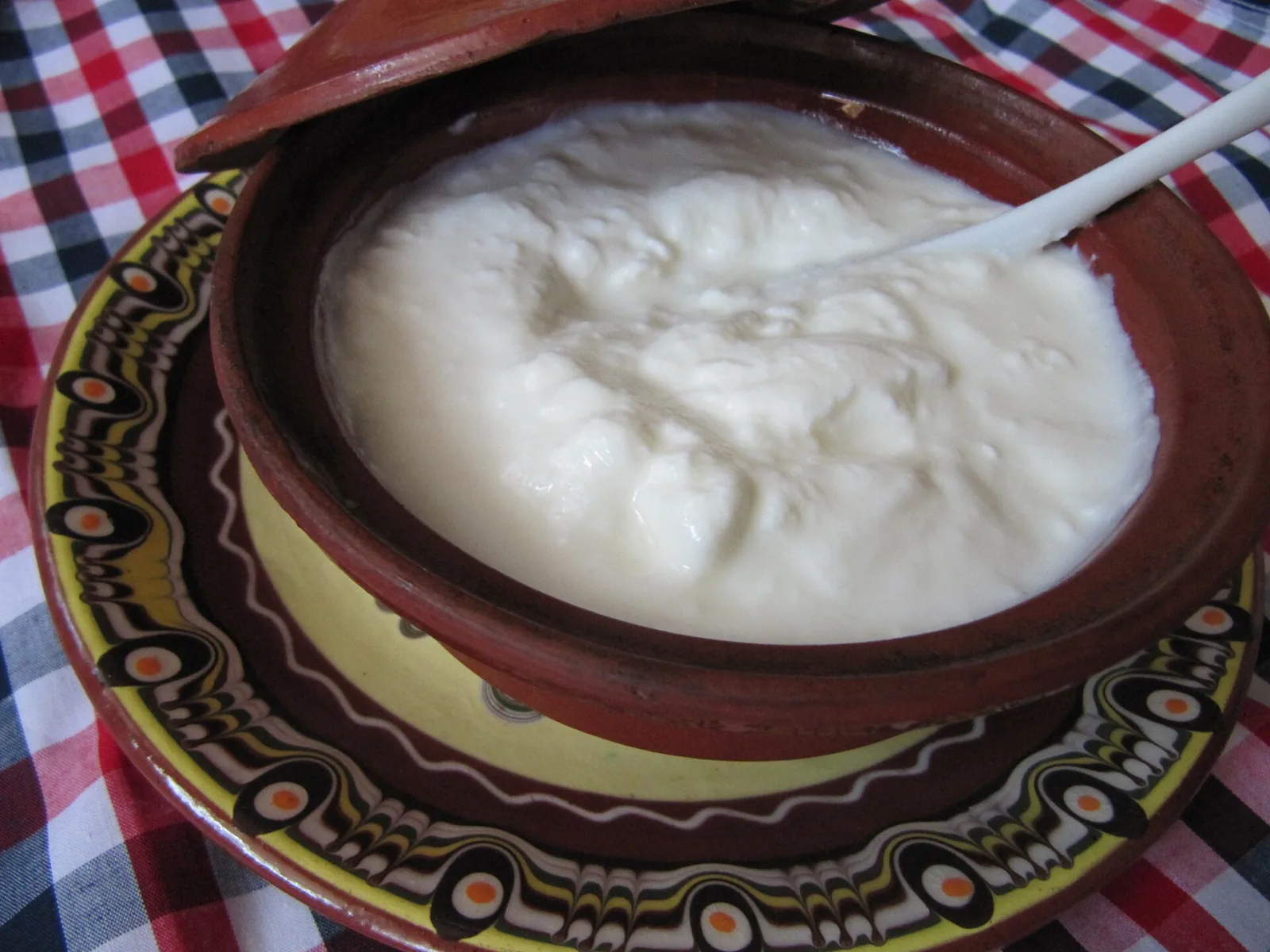
Photo: Ned Jelyazkov / CC BY-SA 3.0 — Wikimedia Commons
Kiselo mlyako, that is, sour milk: a staple of the Bulgarian table, a story told through a bacterium's 1905 description and a small yoghurt museum near Pernik.
In Bulgarian, yoghurt is called “kiselo mlyako” (кисело мляко), that is, “sour milk”.
The Story of a Bacterium
According to Bulgarian Wikipedia, Stamen Grigorov (1878–1945), while a medical student in Geneva, described in 1905 the rod-shaped lactic acid bacterium in yoghurt; the bacterium was named Lactobacillus bulgaricus in 1907 and is today listed as Lactobacillus delbrueckii subsp. bulgaricus. In 1917 Orla-Jensen showed that yoghurt ripens not with this bacterium alone but together with Streptococcus thermophilus. The two species work interdependently: according to the same source, when one is alone, fermentation does not take place; the milk is kept warm at about 30–45 °C for four to twelve hours.
This account has a subtlety: the same Wikipedia article also writes that the origin of yoghurt is unknown and that it may have been found independently in many places in very ancient times. So Bulgaria's share is not the invention of yoghurt but the scientific description of the bacterium in its starter. According to English Wikipedia, in the 1950s the Bulgarian state yoghurt company patented a particular bacterial mixture and promoted it as “official Bulgarian yoghurt”; this mixture is still exported to producers in many countries.
The Yoghurt Museum
According to the Kiselo mlyako article of Bulgarian Wikipedia, the Yoghurt Museum is in the village of Studen Izvor; according to English Wikipedia, Grigorov was born in this village in the Tran municipality, which belongs to Pernik province. The museum is not in the Burgas region but in the west of the country.
- Short glossary: kiselo mlyako (кисело мляко) yoghurt, sirene (сирене) white brined cheese.
- The museum in Grigorov's village lies outside a Burgas trip; it requires a separate route.
Origin Theories and Scientific Fame
Bulgarian Wikipedia also lists theories about the origin of yoghurt: one theory says the Thracians cultured sheep's milk with old milk to obtain a product called “prokish”, though some authors think this belongs to the realm of fable. Another theory rests on the tradition of kumis, made by the Proto-Bulgarians from mare's milk, and “katik”, made by culturing sheep's milk with cheese residue. The same article writes that the main reason for the widespread belief in Bulgaria that yoghurt is Bulgarian is Grigorov's discovery, and that according to the American historian of the Ottoman Empire Mary Neuburger this thesis was first spread in socialist Bulgaria.
It is also told that the Russian biologist Ilya Mechnikov (1845–1916) had a share in yoghurt's recognition in the world: according to Bulgarian Wikipedia, Mechnikov, working at the Pasteur Institute, thought that lactobacilli could reduce the harmful effects that accelerate ageing, consumed yoghurt regularly in the last 10 years of his life and linked the many centenarians in Bulgaria to this habit. English Wikipedia, for its part, records that Grigorov completed his secondary education in Montpellier and his medical education in Geneva; that he made his 1905 discovery in the laboratory of Prof. Léon Massol; and that Google commemorated him with a Doodle of the day on 27 October 2020.
Source: Wikipedia (bg), „Кисело мляко” — https://bg.wikipedia.org/wiki/Кисело_мляко ; Wikipedia (en), „Stamen Grigorov” — https://en.wikipedia.org/wiki/Stamen_Grigorov . Accessed: 2026-10-07.
Text licence: The text of this article has been adapted into English from information taken from Wikipedia (CC BY-SA 4.0); it has been summarised and rewritten, i.e. MODIFIED. Under the same licence condition (share-alike), this article is also offered under the CC BY-SA 4.0 licence: https://creativecommons.org/licenses/by-sa/4.0/deed.en. The source pages are listed in the "Source:" line above.